
An Interview with Mattie Lubchansky
Newsletter Recipients,
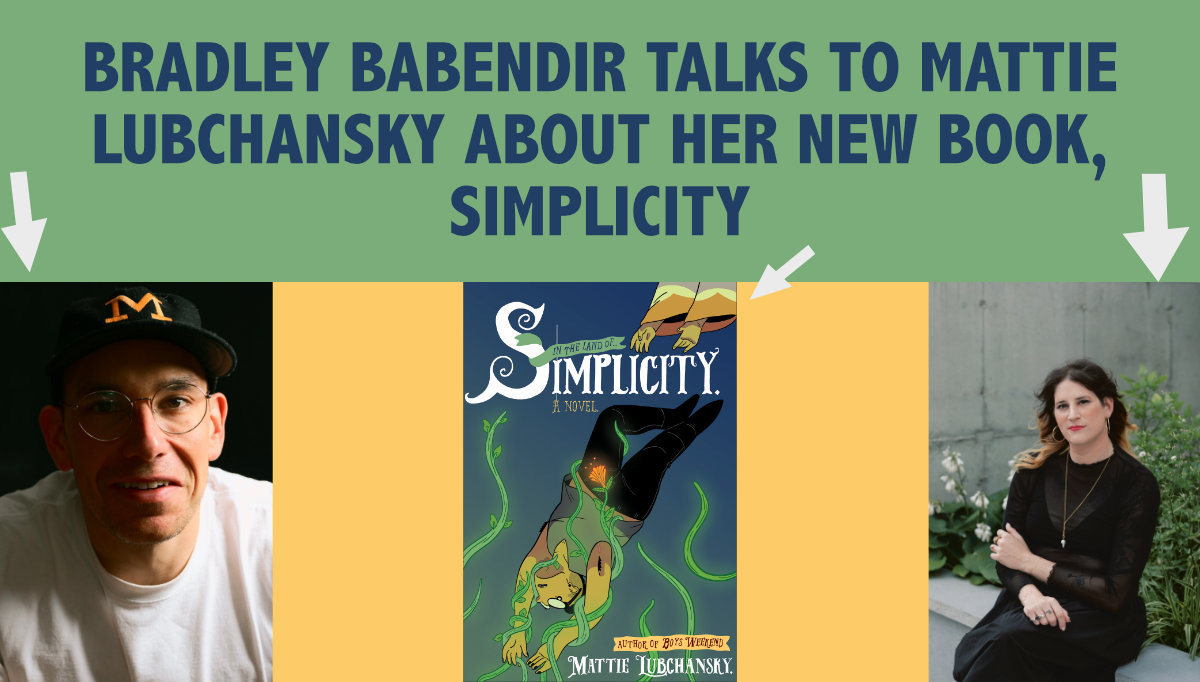
I’m so excited to share this interview with Mattie Lubchansky. We talked about her funny, freaky, and scary new graphic novel Simplicity. I hope you enjoy the conversation as much as I enjoyed having it! She was very tolerant of and gave great answers to my naive ‘so…how does writing a comic…work?’ questions.
Lubchansky is also the author of Boys Weekend and The Antifa Super Soldier Cookbook. You can read her webcomic Please Listen To Me and support her work on Patreon and receive monthly updates via her newsletter!
And with that, on to the show.
This is a Newsletter: This is just a question to get things started for the readers: Can you describe Simplicity in your own words?
Mattie Lubchansky: Simplicity takes place in the near-ish future, where America has collapsed into walled city-states, with vast stretches of lawless wilderness in between. The book follows the story of Lucius, a fastidiously organized and sexually closed-off trans man hired by the mayor/CEO of the New York City Administrative and Security Territory to perform an ethnography of a utopian "cult" that's been living in the Catskill mountains since the 1970s for a new museum being built. Then things get really weird.
TIAN: Both Simplicity, and your last graphic novel, Boys Weekend, have elements of dystopian sci-fi and horror and are also very funny. Can you talk a little about developing that style?
ML: In terms of the humor, that's always going to be in my work whether I want it to or not – I spent so much time developing the muscle as a 4-panel gag cartoonist that it'll always just be there, I was barely consciously trying to write "jokes" into this book, but it does still read that way! I think my time spent doing weekly political strips at The Nib (where I contributed for most of its 10 years and also served as its Associate Editor) really informed that. The horror kind of works hand-in-hand with the humor I think, it's almost the same muscle to use – I'm barely the first person to say this, but it's the same process of understanding a reader's expectations and working with that to surprise them one way or another. The dystopian science fiction is where I like to live as an author and an artist because it's a genre really beloved to me and it's maybe the easiest way to talk about the last 3 or 4 decades of American society – but also in the case of Simplicity it was a deliberate choice, since so much of it is grappling with its utopian themes.
TIAN: How did you go about building the visual style for dystopian New York and the Utopian Catskills community? What was the process of figuring out what it looked like? I'm a person who had to cheat in middle school art. I just re-read Peter Mendelsund's What We See When We Read where he talks about how little descriptive detail is in even relatively-descriptive non-graphic novels and obviously you can't get away with that.
ML: For building out the settings, I really wanted to set a huge contrast for them, so when they collide in the book it's maximally disorienting. The NYC-AST (as it's called in the book) design you don't see a ton of, but I spent a lot of time building it out – I tried to draw a straight line from issues in the country today to what our future could look like, especially in the realm of surveillance and separation. Everyone is being watched, constantly. The big walls and guard towers were pretty inspired by the "West Bank Barrier" apartheid walls. But in comics, this kind of stuff is all downstream from the story. It's all there to place the reader where they need to be as fast as possible. The abandoned summer camp in Simplicity was a little, well, simpler to figure out – the visuals were heavily influenced by a summer camp I went to as a kid, Bucks' Rock, a really important place to me. The layout was inspired a lot by reading a bunch about 19th century utopian socialist communities all across America – the idea of the big meeting house where everyone goes wild every night is very Shaker.
TIAN: Both Boys Weekend and Simplicity are built around these contrasting settings, though in one the main character goes to a dystopian place and in the other the main character goes to a utopian place. What's interesting to you narratively, artistically, politically, etc about juxtaposing those places?
ML: It's funny you ask about this – I was pretty far into writing Simplicity when I realized it was kind of the opposite plot. I think I'm really interested in how people can get radicalized. In the case of Sammie in Boys Weekend, there's someone who has their life already pretty figured out but doesn't realize it. In the case of Lucius and Simplicity, here's someone that basically lives in Hell and has no idea. I'm also, in general really very interested in utopian separatism as a phenomenon – what about which conditions people are living in in what time cause them to think that they can go pitch a tent completely outside of "society" and that it'll work? What does "working" look like? Will that stop the rest of the world from showing up at your door?
TIAN: Do you remember what the initial "in" was in terms of your interest in utopian separatism? It's not something I know much about.
ML: So I've had a long, long fascination with conspiracy theories – cryptids, UFOs, things of this nature – and at some point it kind of naturally extended to "cults." When I was developing this story it was less about utopianism and separatism, I just had the world of the city, and Lucius, and these ecstatic visions he was suffering in the countryside. I knew he was staying with a cult (or something considered one by the outside) but less about their motivations. I was talking to my friend, the novelist Calvin Kasulke (ed note: author of Several People Are Typing) and he recommended the book Paradise Now: The Story of American Utopianism, which kicked off all this research for me. I really become obsessed and found a lot of similarities in the political climate at the time – the industrial revolution had so upended and reorganized American life that people thought the world was ending. They were living through the birth of modern capitalism, and I think we're also dealing with it morphing into something unknown and terrifying.
TIAN: I think we can probably talk about this without spoiling too much but capitalism morphing into something 'unknown and terrifying' has both a metaphorical and literal meaning in Simplicity (and Boys Weekend as well, though in sort of an inverted way). This ties in obviously with the different genre elements we were talking about earlier. Can you say a little bit about how you think about those monster elements? Probably ties in to your interest in cryptids too?
ML: Sure thing. I think monster stories, generally right, are about these physical manifestations of either some emotional force, whether it be a fear or a trauma or whatever. The monsters in the book definitely adhere to that philosophy. I think I’m just really interested in how people sublimate their real feelings into these metaphysical objects.
TIAN: I really love your creatures designs and I’m interested in the process for creating them, what bumps you hit in design, etc. Is this metaphorical stuff front of mind or is it more intuitive? (Though those things aren’t necessarily at odds I guess either!)
ML: Thanks! For the sort of nameless let's call them "tentpole" creatures of the book – that was a little more intuitive. The big green guy's (who I was calling "big sexy" in the writing) design was born from the original kind of ecstatic vision I had that kickstarted me working on the book – originally it was going to be a deer's head mounted on the wall, and the rest of this huge thing was gonna slither out, and Lucius was going to crawl into this big sticky hole and emerge on the other side into a different kind of existence. I ended up spiking the idea since I realized there's no way the people in the town of Simplicity would stand for an animal head being mounted in one of their rooms! The other monster (who I called "big nasty") was basically me trying to feel out the complete opposite of this big, striking, sexy kind of thing. The third monster, ("Chauncey," in the book I think he's called), was me trying to feel out something as unnatural as possible. I iterated a lot on him and it came less intuitive to me, you're seeing like the tenth design of that guy. But this idea that it was just sort of full of slithering tentacles, and not even really alive in any true sense, emerged and ended up in most of the designs.
TIAN: I'm interested in how you think about fiction and nonfiction. Were you always interested in fiction writing/writing a graphic novel? Was there something you felt like you weren't able to explore or accomplish in nonfiction/commentary that led you to fiction?
ML: This is my third book, so I think it's safe to say I've been interested in it a long time! Doing longer-form fiction was always my goal and doing "political cartoons" was something I sort of fell backwards into. I've just always been way more drawn to it – and I think you can see it in my political work that I've always been more into speculative fiction that I was talking about the current events in a given week.
TIAN: Are there any graphic novels you read when you were younger or when you were getting started that you feel like were really influential/inspiring/etc for you?
ML: I was really, really inspired by the Alan Moore/Steve Bissette 1980s run on Swamp Thing. It engages with psychedelia in a way that I thought was really interesting, and reframes the Swamp Thing as a guy that wants to have sex with his girlfriend and get high on yams, which I really appreciated. Early on in the process of writing Simplicity I was also reading E.M. Carroll's Through the Woods, but I've been reading their work for years and years and years and remain consistently in awe of how they play with suspense and gore and the dreamy atmosphere they manage to hold onto.
TIAN: Is there a book (aside from your other books) that you'd recommend to people as a double feature sort of thing with Simplicity?
ML: Amazingly I think I have two answers for this! One would be Grace Byron's upcoming Herculine, a book I loved, which I thought was engaging with a few of the same ideas from a much, much different angle. It's out in October. The other is my friend Elijah Kinch-Spector's fantasy novel Kalyna the Cutthroat (ed note: and Kalyna the Soothsayer)!, which I know stemmed from very similar obsessions with utopian thinkers that Simplicity did.
TIAN: What's the last great book you've read?
ML: I've read a lot of great stuff lately, actually! In terms of books that have come out in the last few months, for nonfiction: Harron Walker's hilarious and funny and thoughtful Aggregated Discontent, and for fiction: Isaac Fellman's Notes From a Regicide, which lit my brain up like a christmas tree.
Until next time,
B